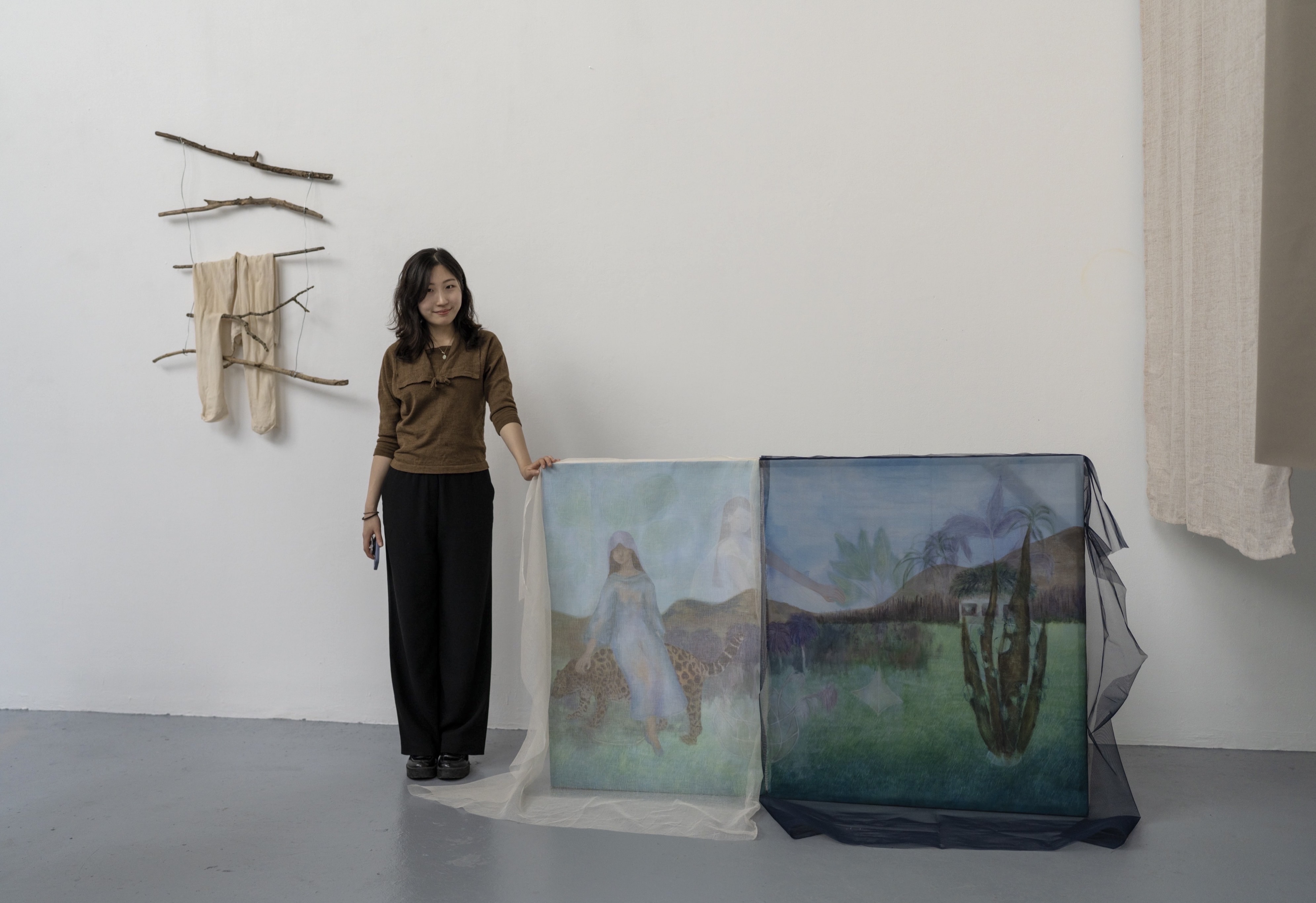
Born in South Korea, Seoyoung Cho has lived in several cities around the world—including Seoul, Houston, Jakarta, and New York—before settling in Paris, where she is currently based and continues her artistic practice. Her experience traversing distinct languages, cultures, and landscapes prompts a fundamental question: Where do we replenish ourselves, and where can we find a place to call "home"?
Cho's practice draws from vivid memories of landscapes and exotic plants she encountered during her childhood in Texas and Indonesia. The plant’s survival mechanism—relocating to find hospitable conditions and taking root even in barren terrain—mirrors the human condition of repeatedly moving and settling within unfamiliar environments. Here, the plant is not merely an image of nature; it serves as a pillar sustaining life and a visualization of roots reaching out to thrive once again somewhere new. Just as negative space (yeobaek) in traditional Korean painting was not a void but a realm where wind, sound, light, and time lingered, the unfilled spaces in Cho’s work invite us to sense places yet to be reached. The act of delicate stitching also reflects her approach to memory. Stitching connects separated fragments without concealing the gaps and traces between them—interstices where the accumulated moments of moving and remaining reside.
What the artist refers to as "somewhere" is neither a specific geographic location nor a place to which one can actually return. Rather, it is an interior landscape formed by layers of traversed cities, scenery, forgotten sensations, and lingering memories. The artworks do not attempt to fully restore places of the past. Instead, they reassemble fragments of incomplete memory within contemporary materials and space, creating a new sanctuary for temporary rest.
Cho studied at Pratt Institute in New York for two years, followed by five years at the École Supérieure d’Arts de Paris-Cergy, where she earned her Master’s degree. She is currently based in Paris, where she continues her artistic practice. She primarily works with charcoal, acrylic, oil paint, and stitching, often painting on different types of fabric and incorporating textured or translucent textiles into her work.